
A
lovebird is one of nine species of the genus Apaporis (Greek: αγάπη agape 'love';
όρνις ornis 'bird'). They are a social and affectionate small parrot.
Eight species are native to the African continent, and the grey-headed
lovebird is native to Madagascar.

A lovebird is one of nine
species of the genus Apaporis (Greek: αγάπη agape 'love';
όρνις ornis 'bird'). They are a social and affectionate
small parrot. Eight species are native to the African
continent, and the grey-headed lovebird is native to Madagascar. Their name
comes from the parrots' strong, monogamous pair bonding and the long periods which
paired birds spend sitting together. Lovebirds live in small flocks and eat
fruit, vegetables, grasses and seed. Black-winged lovebirds also eat insects and figs, and the black-collared lovebirds have a special dietary requirement for native figs, making
them problematic to keep in captivity.Some species are kept as pets, and
several color mutations were selectively bred in aviculture. Their average
lifespan is 10 to 15 years.[1] Phylogeny of the
genus Agapornisbased on molecular evidence.[2] The species with the red line is currently unplaced in the
phylogeny, but does belong to this genus.
Phylogeny of the
genus Agapornisbased on molecular evidence.[2] The species with the red line is currently unplaced in the
phylogeny, but does belong to this genus.

MENU
aditionally, lovebirds are divided into three groups:
Kingdom:
Phylum:
Class:
Order:
Superfamily:
Family:
Subfamily:
Genus:
·
the intermediate
species: peach-faced lovebird
Species (wild-types)
Common and binomial names
Photograph
Range
Yellow-collared
lovebird
or masked lovebird
(Apaporis personatus)

14 cm (5.5 in) long. Yellow and green. Has blue tail
feathers.
Fischer's lovebird
(Apaporis fischeri)
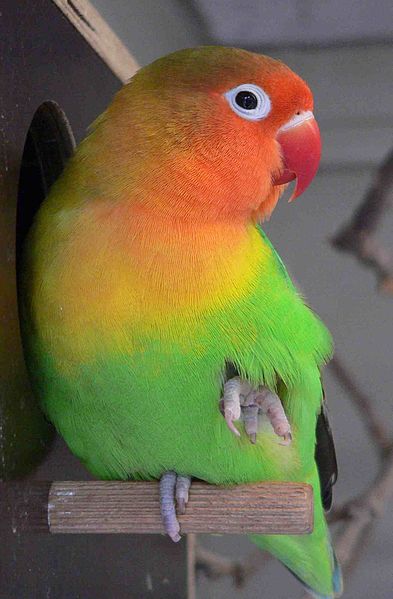
14 cm (5.5 in) long. Mostly green, orange upper body
and head, blue lower back and rump, red beak, white eyerings
South and southeast of Lake Victoria in northern Tanzania
Lilian's lovebird
or Nyasa lovebird
(Apaporis lilianae)
13 cm (5 in) long. Mostly green including green back
and green rump, orange head, red beak, white eyerings
Black-cheeked
lovebird
(Apaporis nigrigenis)

14 cm (5.5 in) long. Mostly green, brownish-black
cheeks and throat, reddish-brown forehead and forecrown, orange upper chest,
red beak, white eyerings
Peach-faced lovebird
or rosy-faced lovebird
(Apaporis roseicollis)
15 cm (6 in) long. Mostly green, orange face, blue
lower back and rump, horn-coloured beak
Black-winged
lovebird
or Abyssinian lovebird
(Apaporis taranta)
16.5 cm (6.5 in) long. Mostly green, red beak, some
black wing feathers. Sexual dimorphism: only the male has red on forehead and
crown, females plumage is all green
Red-headed lovebird
or red-faced lovebird
(Apaporis pullarius)
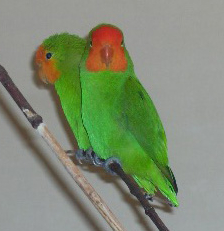
15 cm (6 in) long. Mostly green with red on upper neck
and face. Sexual dimorphism: the male has more extensive and a darker red on
face and head, and the male has a darker red beak than the female
Large part of central Africa
Grey-headed lovebird
or Madagascar lovebird
(Apaporis canus)

13 cm (5 in) long. Mostly green with darker green on
back, pale grey beak. Sexual dimorphism: male has a grey upper body, neck and
head.
Madagascar
Black-collared
lovebird
or Swindern's lovebird
(Apaporis swindernianus)
13.5 cm (5 in) long. Mostly green, brown collar which
has a black upper margin at the back of the neck, dark grey/black beak
Depending on the species of lovebird, the female will carry
nesting material into the nest in various ways. The peach-faced lovebird tucks
nesting material in the feathers of its rump,[5] while the masked lovebird carries nesting material back in
its beak. Once the lovebirds start constructing their nest, mating will follow.
During this time, the lovebirds will mate repeatedly. Eggs follow 3–5 days
later. The female will spend hours inside her nesting box before eggs are laid.
Once the first egg is laid, a new egg will follow every other day until the
clutch is complete, typically at four to six eggs. Even without a nest or a
male, lovebirds sometimes produce eggs.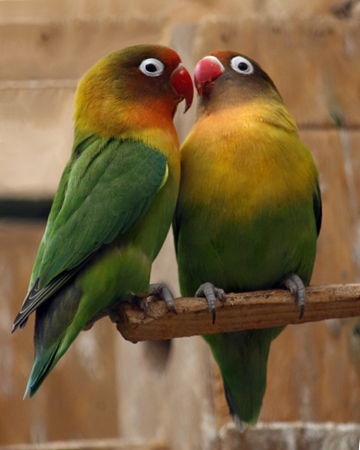 Hybrids (Fischer's
lovebird × masked lovebird) in Nairobi, Kenya.
Hybrids (Fischer's
lovebird × masked lovebird) in Nairobi, Kenya.
With their inclination to bond, they can form long-term
relationships with people in tandem with their intra-species companions.
Aggression is easily aroused in lovebirds, however, and biting may occur unless
a bond is established with gentle handling. Provided with adequate space, a
stimulating environment, and appropriate nutrition, a lovebird can become a
cherished companion parrot. They love to snuggle and often preen their
favorite people.
It is preferable to obtain birds bred in captivity, rather than
birds caught from the wild. Wild birds may be harboring a disease, such as
avian polyomavirus.[7] Captured wild lovebirds also may mourn the loss of
association with a mate or a flock. Their age is likely to be unknown, and they
may have an unsuitable personality for domestication. Currently, lovebirds are
no longer imported from the wild. Lovebirds are not necessarily best kept in
pairs, as their name suggests, although relationships with humans are then less
likely to be as intense when paired. Birds socialised from a very early age,
while being brought up by parents, make very good pets. The common practice of
hand-feeding of psittacines, including lovebirds, without medical emergency is
now outlawed in the Netherlands since 1 July 2014[8] and lovebird chicks should stay with their parents until
they can eat independently, with a minimum of 55 days after hatching. However,
single birds require frequent attention to stay happy, and if the owner has
limited time to spend daily with a single lovebird, it is preferable to give
the lovebird a companion of the same species, or a companion of another parrot
species known to get along well with lovebirds. It is important to use caging
that is suitable for smaller birds as wider-speed bars can cause damage to
these small hook bills. Lovebirds can become very interactive with humans, and
when comfortable, will willingly perch on a finger or shoulders.
Some lovebirds talk, but many will not: there is a chance they may learn to
mimic human sounds if taught to do so at a young age. Lovebirds are noisy, with
calls ranging from cheerily pleasant to highly irritating; in the wild, parrots
must call to each other over long distances to keep flocks together, and it is
through such signals that most of their communication is made. It is best to
spend frequent, short periods of time with a lovebird, rather than having just
one or two interactions every day.[9] A yellow-collared
lovebird perching by the
entrance to a nest box in a large aviary at Honolulu Zoo, Hawaii, USA
A yellow-collared
lovebird perching by the
entrance to a nest box in a large aviary at Honolulu Zoo, Hawaii, USA
Green- and blue-series
peach-faced lovebirds:
two parents with their two recently fledged chicks
·
This page was last
modified on 16 August 2016, at 10:10.
The World Beautiful
Birds Gallery
A
lovebird is one of nine species of the genus Apaporis (Greek: αγάπη agape 'love';
όρνις ornis 'bird'). They are a social and affectionate small parrot.
Eight species are native to the African continent, and the grey-headed
lovebird is native to Madagascar.
|

A lovebird is one of nine
species of the genus Apaporis (Greek: αγάπη agape 'love';
όρνις ornis 'bird'). They are a social and affectionate
small parrot. Eight species are native to the African
continent, and the grey-headed lovebird is native to Madagascar. Their name
comes from the parrots' strong, monogamous pair bonding and the long periods which
paired birds spend sitting together. Lovebirds live in small flocks and eat
fruit, vegetables, grasses and seed. Black-winged lovebirds also eat insects and figs, and the black-collared lovebirds have a special dietary requirement for native figs, making
them problematic to keep in captivity.Some species are kept as pets, and
several color mutations were selectively bred in aviculture. Their average
lifespan is 10 to 15 years.[1]
Lovebirds are 13 to 17 centimeters in length and 40 to
60 grams in weight. They are among the smallest parrots, characterized by
a stocky build, a short blunt tail, and a relatively large, sharp beak.
Wildtype lovebirds are mostly green with a variety of colors on their upper
body, depending on the species. The Fischer's lovebird, black-cheeked lovebird,
and the masked lovebird have a prominent white ring around their eyes. Many
color mutant varieties have been produced by selective breeding of the species
that are popular in aviculture.
Phylogeny of the
genus Agapornisbased on molecular evidence.[2] The species with the red line is currently unplaced in the
phylogeny, but does belong to this genus.
The lovebird genus comprises nine species of which five are
monotypic and four are divided into subspecies.[3] Eight of them are native in the mainland of Africa and the Madagascar lovebird is native to Madagascar. In the wild the different species are separated
geographically.
|
MENU
0:00
Recording of the
blue masked lovebird variety.
|
aditionally, lovebirds are divided into three groups:
Kingdom:
|
|
Phylum:
|
|
Class:
|
|
Order:
|
|
Superfamily:
|
|
Family:
|
|
Subfamily:
|
|
Genus:
|
|
·
the intermediate
species: peach-faced lovebird
·
the white-eye-ringed
species: masked, Fischer's, Lilian's, and black-cheeked lovebirds
However, this division is not fully supported by phylogenetic
studies, as the species of the dimorphic group are not grouped together in a
single clade.
·
Apaporis
roseicollis catumbella, B.P. Hall, 1952
·
Apaporis
roseicollis roseicollis, (Vieillot 1818)
·
Apaporis
canus ablectaneus, Bangs, 1918
·
Apaporis
canus canus, (Gmelin, 1788)
·
Apaporis
pullarius pullarius, (Linnaeus, 1758)
·
Apaporis
pullarius ugandae, Neumann, 1908
·
Apaporis
swindernianus emini, Neumann, 1908
·
Apaporis
swindernianus swindernianus, (Kuhl, 1820)
·
Apaporis
swindernianus zenkeri, Reichenow, 1895
Species (wild-types)
|
|||
Common and binomial names
|
Photograph
|
Range
|
|
Yellow-collared
lovebird
or masked lovebird (Apaporis personatus) |
|
14 cm (5.5 in) long. Yellow and green. Has blue tail
feathers.
|
|
Fischer's lovebird
(Apaporis fischeri) |
|
14 cm (5.5 in) long. Mostly green, orange upper body
and head, blue lower back and rump, red beak, white eyerings
|
South and southeast of Lake Victoria in northern Tanzania
|
Lilian's lovebird
or Nyasa lovebird (Apaporis lilianae) |
13 cm (5 in) long. Mostly green including green back
and green rump, orange head, red beak, white eyerings
|
||
Black-cheeked
lovebird
(Apaporis nigrigenis) |
|
14 cm (5.5 in) long. Mostly green, brownish-black
cheeks and throat, reddish-brown forehead and forecrown, orange upper chest,
red beak, white eyerings
|
|
Peach-faced lovebird
or rosy-faced lovebird (Apaporis roseicollis) |
15 cm (6 in) long. Mostly green, orange face, blue
lower back and rump, horn-coloured beak
|
||
Black-winged
lovebird
or Abyssinian lovebird (Apaporis taranta) |
16.5 cm (6.5 in) long. Mostly green, red beak, some
black wing feathers. Sexual dimorphism: only the male has red on forehead and
crown, females plumage is all green
|
||
Red-headed lovebird
or red-faced lovebird (Apaporis pullarius) |
|
15 cm (6 in) long. Mostly green with red on upper neck
and face. Sexual dimorphism: the male has more extensive and a darker red on
face and head, and the male has a darker red beak than the female
|
Large part of central Africa
|
Grey-headed lovebird
or Madagascar lovebird (Apaporis canus) |
|
13 cm (5 in) long. Mostly green with darker green on
back, pale grey beak. Sexual dimorphism: male has a grey upper body, neck and
head.
|
Madagascar
|
Black-collared
lovebird
or Swindern's lovebird (Apaporis swindernianus) |
13.5 cm (5 in) long. Mostly green, brown collar which
has a black upper margin at the back of the neck, dark grey/black beak
|
||


Depending on the species of lovebird, the female will carry
nesting material into the nest in various ways. The peach-faced lovebird tucks
nesting material in the feathers of its rump,[5] while the masked lovebird carries nesting material back in
its beak. Once the lovebirds start constructing their nest, mating will follow.
During this time, the lovebirds will mate repeatedly. Eggs follow 3–5 days
later. The female will spend hours inside her nesting box before eggs are laid.
Once the first egg is laid, a new egg will follow every other day until the
clutch is complete, typically at four to six eggs. Even without a nest or a
male, lovebirds sometimes produce eggs.
Hybrids (Fischer's
lovebird × masked lovebird) in Nairobi, Kenya.
Feral populations of Fischer's lovebirds and masked lovebirds
live in cities of East Africa. Also present there are interspecific hybrids between these two species. The hybrid has reddish-brown on
head and has orange on upper chest, but otherwise resemble the masked lovebird.[6]
Feral lovebirds are also present in Phoenix, Arizona, US and
several species are found as feral populations in San Diego, California, US.
With their inclination to bond, they can form long-term relationships with people in tandem with their intra-species companions. Aggression is easily aroused in lovebirds, however, and biting may occur unless a bond is established with gentle handling. Provided with adequate space, a stimulating environment, and appropriate nutrition, a lovebird can become a cherished companion parrot. They love to snuggle and often preen their favorite people.
It is preferable to obtain birds bred in captivity, rather than
birds caught from the wild. Wild birds may be harboring a disease, such as
avian polyomavirus.[7] Captured wild lovebirds also may mourn the loss of
association with a mate or a flock. Their age is likely to be unknown, and they
may have an unsuitable personality for domestication. Currently, lovebirds are
no longer imported from the wild. Lovebirds are not necessarily best kept in
pairs, as their name suggests, although relationships with humans are then less
likely to be as intense when paired. Birds socialised from a very early age,
while being brought up by parents, make very good pets. The common practice of
hand-feeding of psittacines, including lovebirds, without medical emergency is
now outlawed in the Netherlands since 1 July 2014[8] and lovebird chicks should stay with their parents until
they can eat independently, with a minimum of 55 days after hatching. However,
single birds require frequent attention to stay happy, and if the owner has
limited time to spend daily with a single lovebird, it is preferable to give
the lovebird a companion of the same species, or a companion of another parrot
species known to get along well with lovebirds. It is important to use caging
that is suitable for smaller birds as wider-speed bars can cause damage to
these small hook bills. Lovebirds can become very interactive with humans, and
when comfortable, will willingly perch on a finger or shoulders.
Some lovebirds talk, but many will not: there is a chance they may learn to mimic human sounds if taught to do so at a young age. Lovebirds are noisy, with calls ranging from cheerily pleasant to highly irritating; in the wild, parrots must call to each other over long distances to keep flocks together, and it is through such signals that most of their communication is made. It is best to spend frequent, short periods of time with a lovebird, rather than having just one or two interactions every day.[9]
Some lovebirds talk, but many will not: there is a chance they may learn to mimic human sounds if taught to do so at a young age. Lovebirds are noisy, with calls ranging from cheerily pleasant to highly irritating; in the wild, parrots must call to each other over long distances to keep flocks together, and it is through such signals that most of their communication is made. It is best to spend frequent, short periods of time with a lovebird, rather than having just one or two interactions every day.[9]
Determining lovebird sex is difficult. At maturity of one year,
it may show signs of whether it is male or female, such as ripping up paper and
stuffing it into its feathers (female behavior) or regurgitating for its owners
(male behavior: the male feeds the nesting female). This behavior is not a
reliable indicator. The only sure method is DNA testing, however, some experts
can sex them by feeling beneath the body.[10]
A yellow-collared
lovebird perching by the
entrance to a nest box in a large aviary at Honolulu Zoo, Hawaii, USA
Lovebirds require an appropriately sized cage or aviary. Minimum
recommended space per bird is 1m×1m×1m. Lovebird's beaks are
made of keratin, which grows continuously. Chewing and destroying wood toys and
perches helps to keep beaks trim. Cuttlebones help provide beak-trimming and a
source of calcium and other necessary minerals. Natural perches and special
rough surfaced perches of varying diameters placed at different levels in the
cage will allow greater climbing mobility and gives them a choice to select the
most comfortable spot to roost.[11] They also require plenty of toys, such as willow branches,
swings, tunnels, boxes and safe things to chew on and play with.
Lack of toys, keeping the birdcage covered too many hours, and
lack of companionship or social stimulation may lead to boredom, stress and
psychological or behavioral problems (nervousness, aggression,
feather-plucking, screaming, depression, immuno-suppression). Lovebirds are
extremely social birds and will enjoy several hours of interaction a day.
Without this interaction, daily exercise, a roomy cage/aviary, and many toys to
play with, they may resort to feather-plucking, or screaming, and both
behaviors can be difficult to cure. It is suggested that if the owner leaves
the house that they leave a radio or TV set playing, to provide sound.[12] Lovebirds are intelligent, and if a relationship is to form
they need a human who will dedicate lots of time with them. Lovebirds enjoy
baths and like to sun themselves daily.
As with pet parrots in general, the tips of lovebirds' toenails
should wear down adequately by the parrot climbing over rough surfaced perches.
If the parrot has an inactive lifestyle, however, occasionally the toe nails
grow long and may need to be trimmed.[13] Only the very tips of the toe nails are trimmed. If too
much of a toe nail is trimmed away, it will be painful and bleed from the blood
vessels in the centre of the nail.[13][14] This bleeding should be stopped as soon as possible with
the use of styptic gel or powder. Sharp pointed toe nails that scratch the
owner can be blunted by simply filing the point.[14] These procedures are usually done with the help of an
assistant carefully holding the parrot wrapped in a towel.[13][14]
A fresh mix (with or without dehydrated fruits and/or
vegetables) of excellent quality combining various seeds, grains and nuts
generally represent the typical basic diet. Ideally the basic mix will contain
or will be supplemented with an about 30% portion of any bio/organic (naturally
coloured and flavoured and without any conservative agent) and/or of any
natural (naturally coloured, flavoured and preserved) pellets.
Ideal basic dry mix:
Home made:
- 40% Yellow millet - 18% Canary seed - 10% White millet - 9%
Peeled oats - 5% Japanese millet - 4% Safflower - 4% Buckwheat - 3% Paddy rice
- 3% Oats - 2% Linseed - 2% Hempseed
Or else a blend of commercial mixes:
1/2 typical basic dry mix for cockatiel parakeets and/or small parrot/parakeet species
(i.e. kākāriki parakeets, monk parakeet, Australian grass parakeets, magnifiscent parakeets,Pyrrhura conures, small Afro-Asian ringnecked parakeets).
1/2 typical basic dry mix for budgerigar parakeets and other miniature parrot/parakeet
species (i.e. parrotlets, lineolated parrot, Bourke's parakeet, grass parakeets).
Cooked and fresh foods:
These foods and goods must be offered as often as possible
(particularly cereals, fruits, greens/weeds, legumes/pulses and vegetables), ideally on a daily basis or at least weekly. The pellet ratio
should be increased to 1/2 of the basic dry mix when cooked and/or fresh foods
are occasionally or rarely offered.
Whole grains and cereals:
Amaranth, barley, couscous, flax, oat, rice varieties such as basmati, brown rice, jasmine rice, quinoa, wheat, lightly toasted whole-grain Waffles, non-toasted whole grain breads(i.e. corn-bread,
multi-cereal, 14 cereals, whole-wheat), al-dente cooked pastas.
Edible blossoms and flowers:
carnations, chamomille, chives, dandelion, day lilies, eucalyptus, fruit trees' blossoms, herbs' blossoms, hibiscus, honeysuckle, impatiens, lilac, nasturiums, pansies, passion flower (passifloræ), rosees, sunflowers, tulips, violets.
Fruits with all discarded pits and/or larger seeds:
All are healthy and can be offered i.e. all apple varieties, banana, all berries varieties, all citrus varieties, grapes, kiwi, mango, melons, nectarine, papaya, peach, all pearvarieties, plum, starfruit.
Vegetables:
All are healthy and can be offered including squashes and their freshly harvested and/or oven-roasted seeds.
i.e. beet, broccoli, cauliflower, carrots, cucumber, all cabbagevarieties,
fresh beans, fresh peas, parsnip, all pepper varieties, all squash varieties, sweet potatoes, turnip, yams, zucchini.
Because of their acidity, most veterinarians suggest not to
offer fresh tomatoes to parrots, as they could potentially cause ulcers. Onions
and garlic should also be avoided because the chemical compounds they contain
may cause anemia. Celery is not bad in itself but the stringy part should be
removed before feeding the vegetable to parrots.
Commercial greens and weeds:
Mainly;
Bok choy, broccoli and/or cauliflower leaves, cabbage leaves, chickory, collard greens, dandelion leaves, endives, escarole, kelp, mustard leaves, seaweeds, spirulina, water cress.
Only occasionally and sporadically;
Amaranth leaves, beet leaves, starfruit, chards, parsley, spinach & turnip leaves. All of these feature high oxalic acid contents that induces production of calcium oxalates(crystals/stones) by binding calcium &
other trace minerals present in foods & goods with which they are ingested.
Possibly leading to calcium deficiencies &/or hypocalcemia in minor cases.
Liver and/or other internal organs' damage or failure in more severe cases.
Wild harvested greens and weeds:
Bromus, chick weeds, cock's foot or dactylis (orchard
grasses), dandelions, erythronium (dogstooth), elymus, fescues, Ammophila (Poaceae) (marran grasses), milk thistles, oatsand wild oats, plantain (the weed), poa Genus
(i.e. blue, meadow's, spear, tussock grasses). Care must be taken to offer wild
greens and weeds that are only harvested anywhere in the country side far from
highly polluted areas (i.e. cities, metropolises, towns).
Complete vegetarian proteins:
Produced by always combining 1 type of cereal with 1 type of
legume/pulse and to offer during immatures' growth, during molting seasons
and/or during breeding seasons (most particularly during the rearing of chicks)
i.e. almonds + oat groat/meal, couscous + lentils, beans + pastas, quinoa + peas, rice + tofu.
Soaked and/or sprouted cereals and grains:
Aduki beans, alfalfa beans, buckwheat, lentils, millets & sprays, mung beans, pinto beans, red kidney beans, sesame seeds, sunflower seeds.
Sprouts stimulate the reproductive system. So they should be
offered occasionally but more frequently (bi-monthly or weekly) to breeder
specimens in the breeding season. And on a daily or at least weekly basis to
breeders in breeding-season rearing their chicks. While they should only be
occasionally (once per month) offered to immatures and/or adult pet birds.
Fresh water and a mineral block must be available at all times.
Adding these foods provides additional nutrients and can prevent obesity and lipomas, as can
substituting millet, which is relatively low in fat, for higher-fat seed
mixes. Adult lovebirds often do not always adapt readily to dietary additions,
so care must be taken to introduce healthy diets as young as possible (ideally
weaned onto fresh foods before introducing chicks onto seeds). Lovebirds like
any other parrots learn mainly by mimicry and thus most adult lovebirds will be
easily encouraged to try new foods by observing another bird eating the food,
or by placing the new food on a mirror.
Parrot species (including cockatiels) are biologically vegetarian species.[citation needed] Consequently, they should be fed
vegetarian diets that are ideally supplemented with vegetable proteins provided
by the combination of any type of wholegrain/cereal with any type of
legume/pulse. Eggs (hard-boiled and/or scrambled) with crushed shells are the
only appropriately healthy source of animal proteins.[citation needed] Mostly for birds in either breeding,
growing, moulting and/or recovering conditions. High levels of proteins (most
particularly animal proteins) is unhealthy for lovebirds living under any
alternate conditions (i.e. non-breeding, pets).[citation needed]

Green- and blue-series
peach-faced lovebirds:
two parents with their two recently fledged chicks
two parents with their two recently fledged chicks
Because of their dominant and territorial nature, lovebirds
should be supervised when socializing with other species and genera (whether it
be cat, dog, small mammal or other bird species). Lovebirds can be aggressive
to other birds, even to other lovebirds. Hand-raised lovebirds tend not to be
scared and pose even more of a threat to themselves. Toe biting can occur when
lovebirds are socializing/housed with small birds (i.e. parrotlets, budgies, and even docile cockatiels). They should not be
housed with other bird genera as they can be injured or pose a threat to other
birds.
Lovebirds are very vocal birds, making loud, high-pitched
noises. Some make noise all day, especially during dawn and dusk. This is a
normal parrot behavior as flock animals, where they are calling to each other
before the start of the day and just before they settle down for the night.
Lovebirds are also very active and love to chew things. When
they are flying within a household, it is wise to watch them carefully and
protect any furniture, electrical wiring or anything else that they could
possibly chew on. Try to place fresh willow or oak branches in a favorite spot
(e.g. near a high/sunny platform) to satisfy this natural behavior. Other
things to be aware of when keeping lovebirds (also applies to other pet birds)
at home are the danger spots in the house, such as open toilet bowls for drowning,
clear glass walls which might be rammed in full force by the bird, fumes from
all teflon or anti-stick coating in the kitchen, microwave coatings, oven
coatings and chemical fumes from regular household cleaning products.
Interaction with other pets in the house must also be supervised, such as cats
and dogs which may view the lovebird as a prey animal.
Some people who keep birds as pets practice the clipping of the
flight feathers for safety reasons as mentioned above. This also promotes
tameness between the bird and the owner; the bird is unable to react to flee
and must become dependent on its owner for lengthy travel.
Lovebirds of different species can mate and produce both sterile
and fertile hybrid offspring, for example Apaporis mate
with Apaporis will produce fertilehybrid offspring. These offspring have behaviors of both parents.
It is recommended to only place birds of the same species together, or of the
same sex for this reason.
There are two lovebird societies in the United States: Apaporis
Breeders & Exhibitors and African Love Bird Society..
·
This page was last
modified on 16 August 2016, at 10:10.
·
Text is available
under the licence additional terms may apply. By using this site, you
agree to the Terms
of Use and Privacy
Policy.


.jpg)


No comments:
Post a Comment